Diagnostic tasks
Refinement decisions, residual interpretation, parameter recovery, phase analysis, and refinement-history assessment.
- 30 easy · 40 medium · 30 hard
- Maximum 20 tool calls
- Exact, objective, and scientific evaluation
Verifiable, stepwise powder X-ray diffraction analysis with executable crystallographic backends and scientific checks.
Powder X-ray diffraction is central to materials characterization, yet reliable end-to-end automation remains challenging. AutoXRD organizes powder-XRD analysis into stepwise refinement procedures, grounds actions in observed evidence, and applies deterministic crystallographic and physical checks before accepting a result.
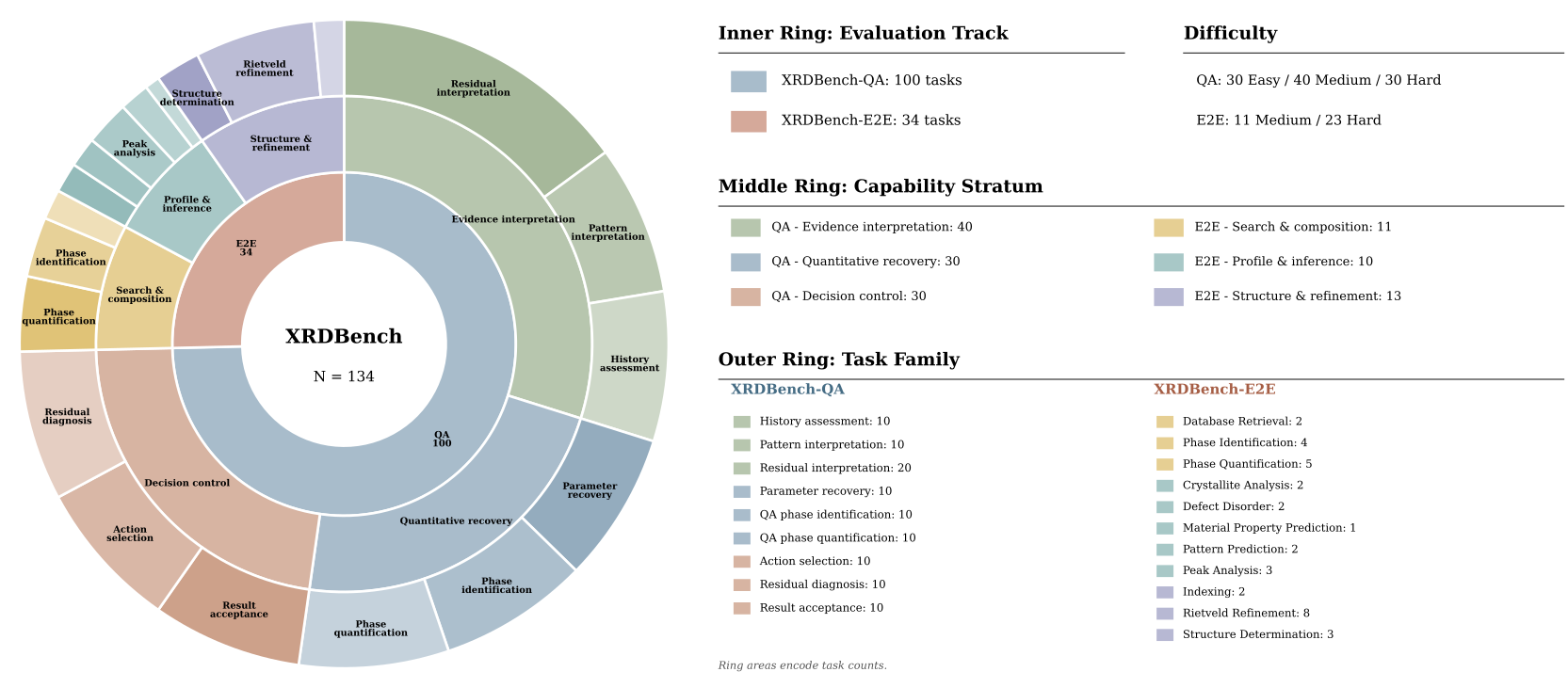
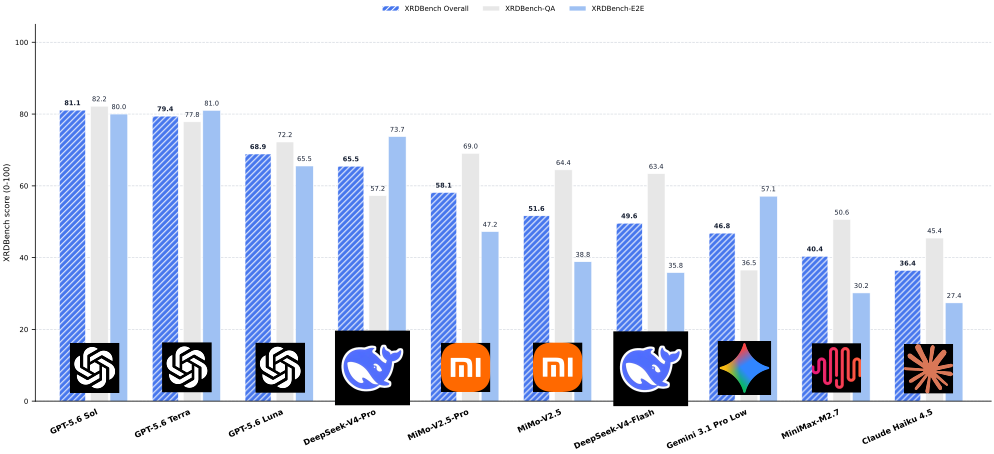
XRDBench evaluates the resulting agents through 100 diagnostic questions and 34 executable workflows across eleven XRD task families. Across ten models, performance decreases from 61.9 on diagnostic QA to 53.7 on E2E workflows, exposing persistent limitations in quantitative reasoning, indexing, Rietveld refinement, and controlled termination.
Planning, refinement backends, physical validation, and auditable trajectories in one agent framework.
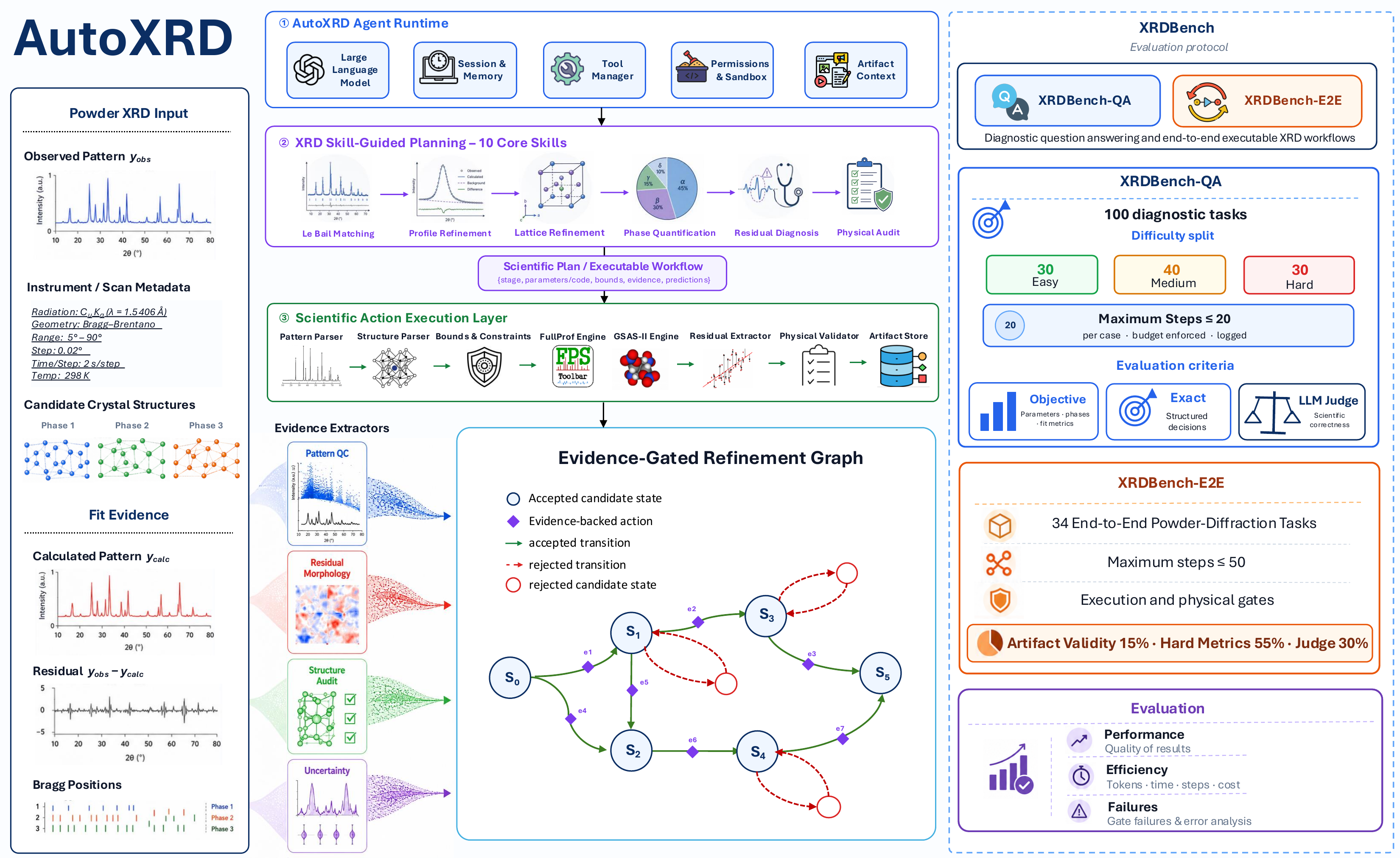
Two complementary tracks test isolated scientific decisions and their composition into executable XRD workflows.
Refinement decisions, residual interpretation, parameter recovery, phase analysis, and refinement-history assessment.
State-changing analyses across eleven XRD task families with artifacts, execution gates, and physical validation.
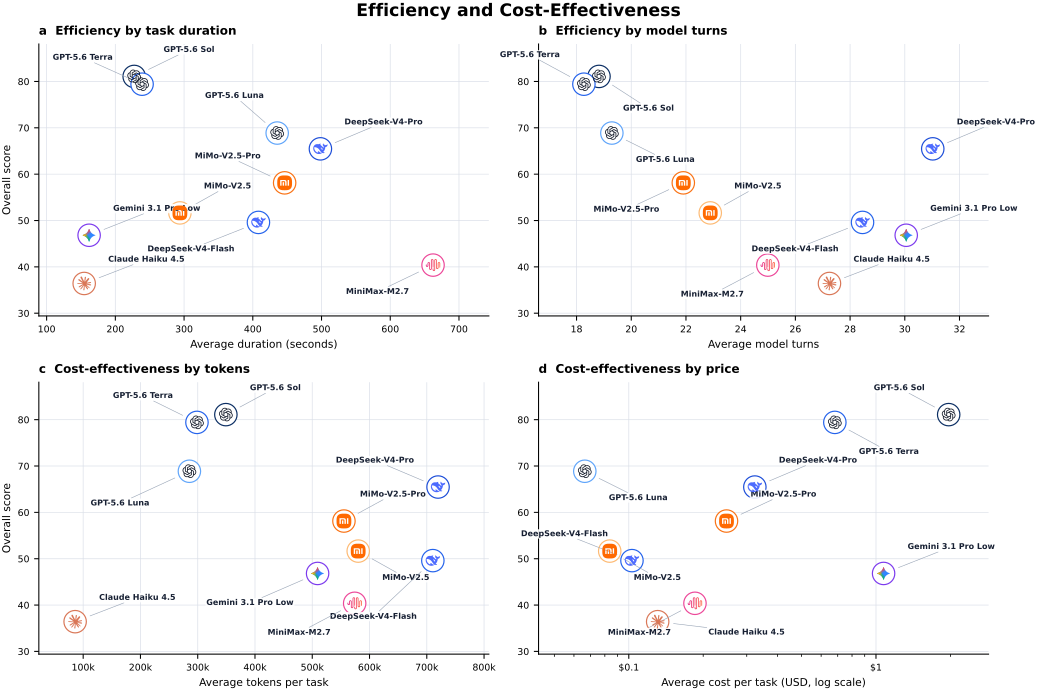
1,340 model–task runs reveal a clear gap between bounded scientific reasoning and autonomous workflow execution.
out of 100 across the two tracks
bounded diagnostic reasoning
executable XRD workflows
GPT-5.6 Sol
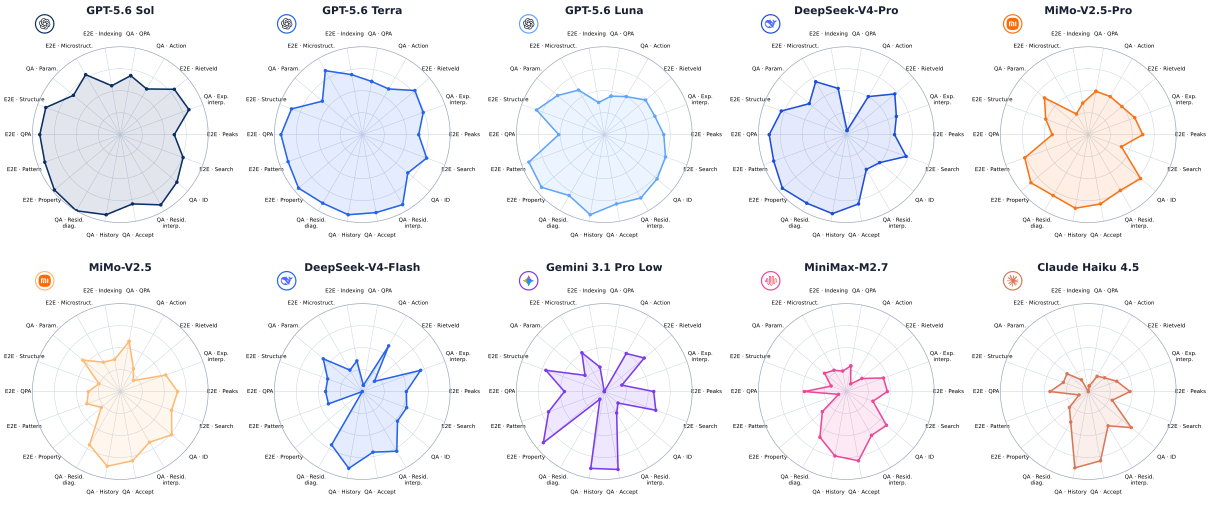
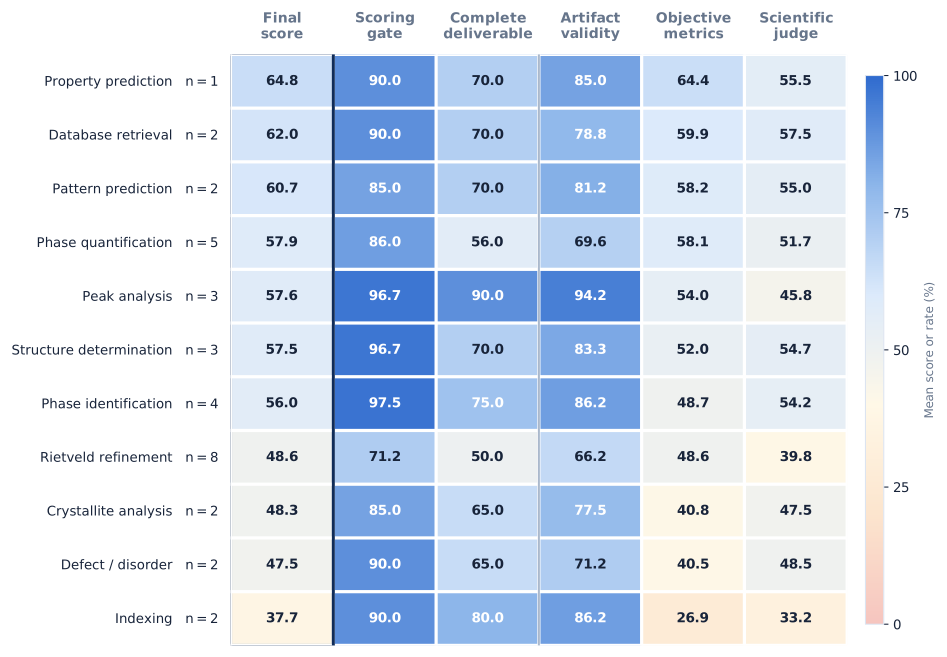 (a) End-to-end task-family bottlenecks
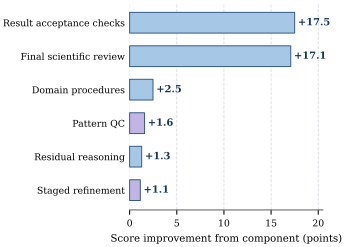 (b) AutoXRD component effects
If you use AutoXRD or XRDBench, please cite our paper.
@misc{wu2026autoxrdautonomousllmagents,
  title={AutoXRD: Autonomous LLM Agents and Comprehensive Evaluation for Powder Diffraction Analysis},
  author={Yuetong Wu and Maojun Sun},
  year={2026},
  eprint={2609.00070},
  archivePrefix={arXiv},
  primaryClass={cond-mat.mtrl-sci},
  url={https://arxiv.org/abs/2609.00070}
}